
Plastics
Blow Molding Thermal Inspection
AI-powered thermal imaging for parison monitoring, molded part inspection, and preform temperature uniformity, to ensure process stability improving both quality and yield.
See blow molding defects as the parts are produced
Blow molders find most quality problems the same way: a leak tester or vision system downstream rejects a bottle, and by then another hundred have been made with the same failure mode.
Eigen installs thermal cameras at the parison and immediately after molding for continuous monitoring of each part as it is extruded, molded, and cooled.
AI models interpret every shot for temperature uniformity, parison shape, wall thickness variation, and other defects or anomalies. Operators see deviations in real time, with the trend data to understand what shifted. Signals can also be output to the PLC to inform machine adjustments for process stability optimization.
Applications
Extrusion blow molding: parison monitoring and length control
In extrusion blow molding (EBM), the consistency of the extruded plastic parison directly determines the structural integrity, wall thickness, and visual quality of the final hollow container or molded part. Traditional inspection methods rely heavily on periodic manual checks or basic spot-temperature sensors, which often catch thermal anomalies only after defective parts are produced.
AI-enabled thermal imaging transforms parison monitoring from a reactive troubleshooting task into a real-time, closed-loop process control system as infrared cameras continuously capture and analyze thermal profiles of the parison as it emerges from the die.
Key benefits of continuous thermal parison monitoring include:
Scrap reduction: understand variation in parison length, thermal profile, hook/swing, and material contamination at the time of extrusion, preventing full runs of non-conforming product
Faster setups: accelerate job changeovers by comparing live thermal profiles against the optimal parison baseline
Material optimization: enable precise lightweighting by ensuring reliable, uniform wall thickness as the parison is extruded
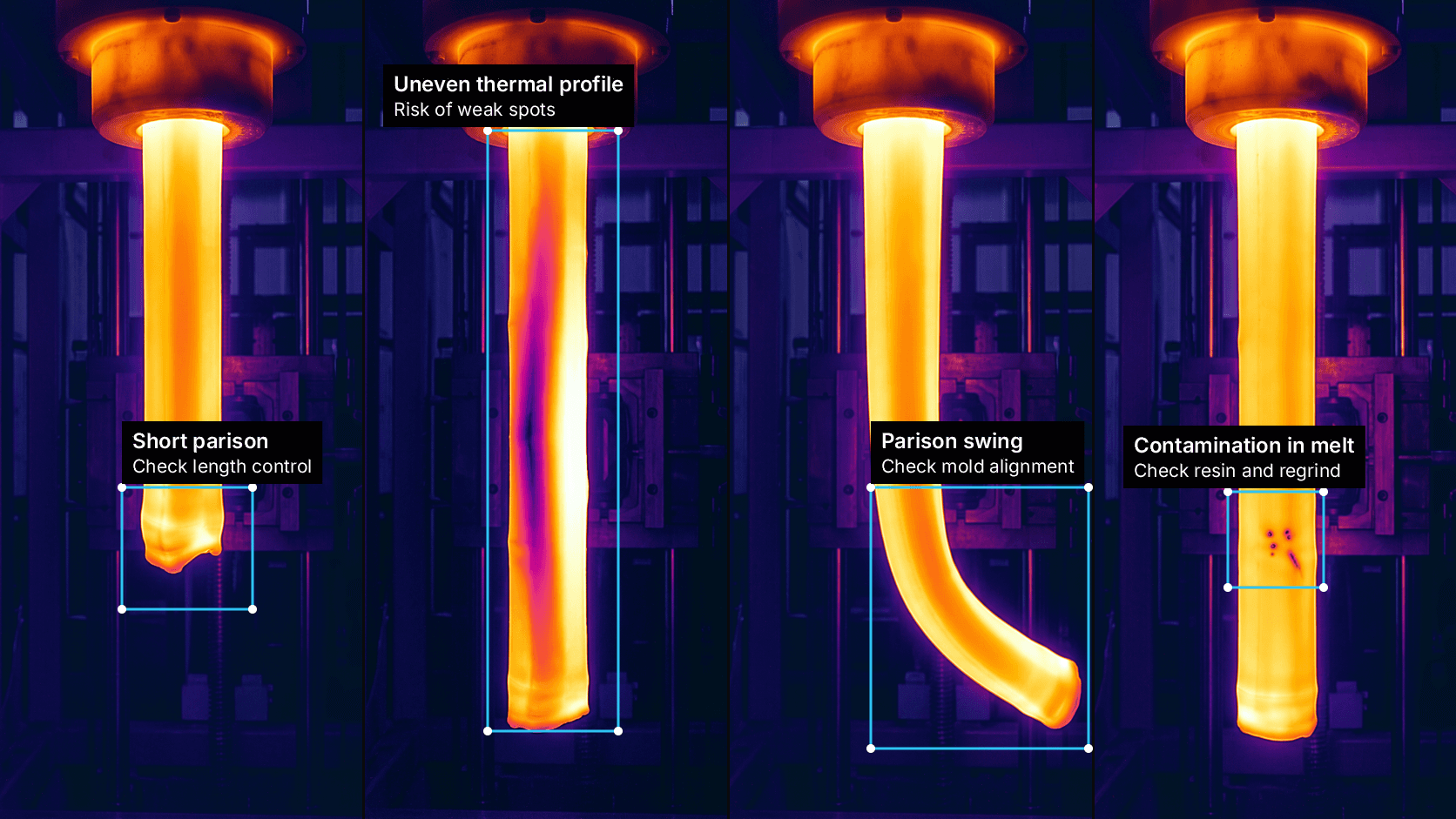
Thermal imaging flags parison length, temperature, hook/swing, and contamination as the parison is extruded.
Extrusion blow molding: molded part and bottle inspection
In extrusion blow molding (EBM), once containers exit the mold cavity, evaluating residual thermal signatures immediately after cooling provides direct insight into part stability and machine health. Whether operating on a shuttle machine (post-cooling release/stripping station) or a rotary wheel machine (at the wheel exit/takeaway point), post-cooling thermal imaging verifies that every part or bottle achieves a uniform thermal profile before entering downstream trimming and packaging.
AI-enabled thermal imaging captures high-speed thermal profiles precisely at the machine exit point, identifying critical structural defects, wall thickness variation, and molding anomalies in real time with analytics tied to the specific mold cavity.
Thermal imaging immediately after molding provides earlier insight into potential quality issues before hundreds of bottles are produced. Common defect types that can be detected include:
Wall thickness variation
Weak blow / incomplete inflation
Deformed bottles
Excess flash
Contamination
Thin base
Handle / shoulder formation

Common failure modes and how they appear in optical and thermal images.
Injection stretch blow molding
In injection stretch blow molding (ISBM), preform temperature control directly impacts biaxial orientation, material distribution, and container clarity. Because PET and other resin formulations have a narrow stretch-blowing processing window, subtle thermal variations along the preform length lead to off-center base gates, wall thinning, and structural issues.
AI-enabled thermal imaging monitors the exact temperature profile of every preform immediately prior to blow molding, delivering predictive quality control for both integrated single-stage and high-speed two-stage machines. Integrated algorithms analyze the temperature of every preform before and after conditioning or reheat to ensure uniformity before molding and trend performance across mold cavities.
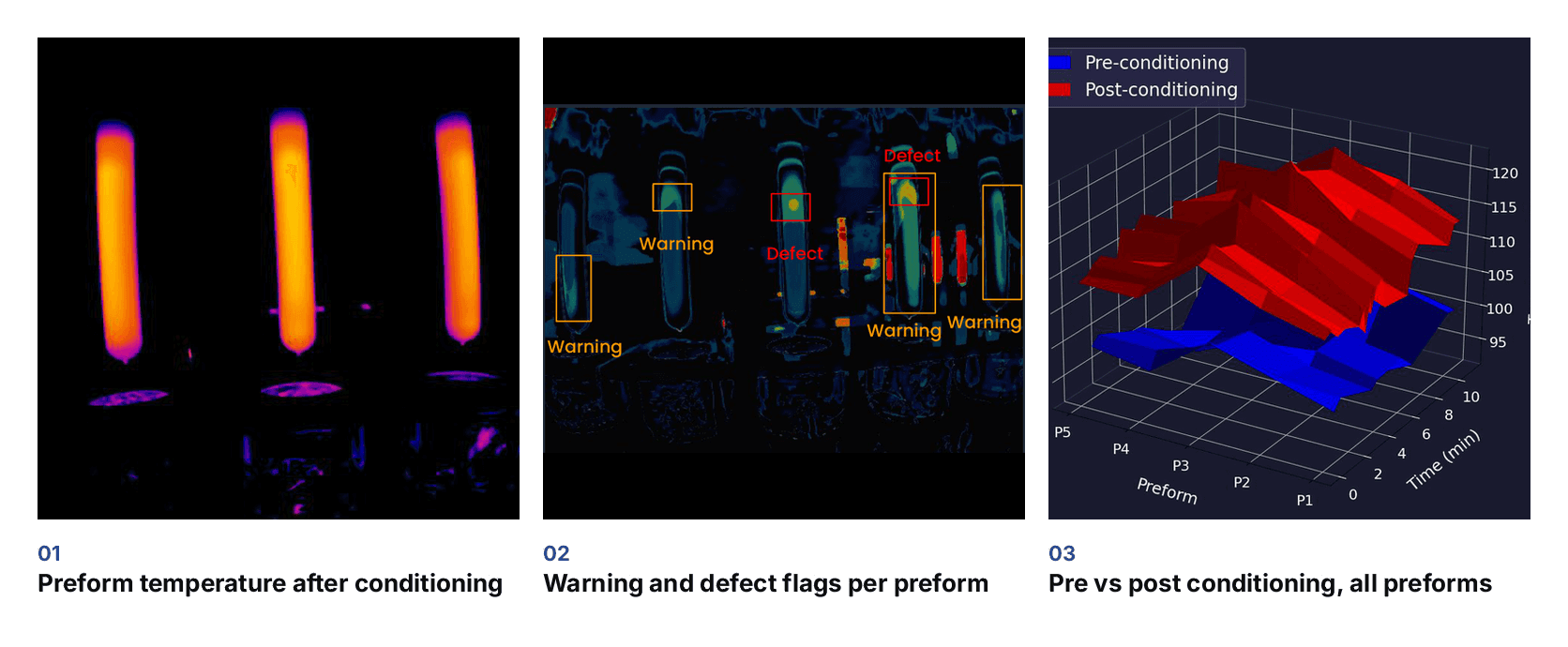
Every preform is checked before and after conditioning, with warnings and defects flagged before molding.
How the system works
Typically one or two industrial thermal cameras are mounted inside the blow molder with sufficient visibility to the parison(s) or preform(s), or at the unloading station facing a single side or both sides of the bottle as it is transferred to the conveyor. The machine's parison-extruded or bottle-present signal triggers each capture, inference runs at the edge (under 10 ms), and results are returned to the machine PLC over EtherNet/IP, Modbus, or OPC UA as Good, Defect, or Fault. Classification of specific defects and relationship to a specific mold cavity can also be enabled.
In Eigen's software, AI models trained on your specific machine, mold, and material interpret every image for shape, temperature uniformity, and other associated defects or anomalies. Operators see the results on an HMI at the line in real time, while data is pushed to OneView Cloud for analytics, trends, and reporting across machines, lines, and plants.
Where thermal AI pays for itself
Startup and changeover
Swing and melt temperature run highest in the first minutes after startup or a mold change and settle slowly, often with a lasting offset between heads. Seeing variation on the HMI in real time enables the operator to optimize the parison program while minimizing downtime and scrap.
Protect the customer relationship
Industrial bottles, drums, and containers that leak on a retail shelf or in a truck are a fast track to losing a customer. Continuous monitoring of wall thickness variation on every container closes the gap between periodic sampling and customer risk, with 100% in-line inspection.
Process stability on multi-parison machines
Knowing the temperature distribution across 4, 6, or 8 heads, and how it drifts over a run, is what enables process engineers to quickly isolate risk and balance material flow rather than chase individual bad bottles.
Frequently asked questions
We already have thermal cameras. How is this different?
Eigen's Thermal Intelligence provides an automated analysis of every shot with trend tracking, severity classification, and control system integration. Instead of following strict rules, the system detects anomalies based on situational context and reduces false warnings to a minimum.
We already have a leak tester and vision inspection downstream. Why add this?
Downstream inspection systems may detect faulty containers, but they tell you late and provide minimal insight into the root cause of the failure.
Which machines does it work on?
The system is machine-agnostic. We've proven it on shuttle and wheel extrusion blow molders, single and multi-parison, from small continuous extrusion lines to single-parison drum and tank machines, as well as single-stage and two-stage injection stretch blow molders.
How long does it take to deploy the system?
Cameras and the edge device can be installed in an afternoon. The first shifts of data collection set a production baseline, so anomaly alerts can start within days. We then train models for your specific failure modes over several weeks until your team validates performance for production deployment. The system is then interlocked to reject parts, or provide other feedback to the control system.
How does the system adapt to material changes?
AI does not just see heat, it sees patterns. By training on thousands of cycles, the system recognizes the thermal signature of a defect before the part or bottle is formed. This reduces the false alerts that a fixed threshold would raise every time regrind ratio or resin lot changes. The system can also be leveraged to understand variation in melt required for recycled polymers to achieve similar performance to virgin material.
Can it adjust the machine automatically?
Our systems typically interlock with the PLC to hold or reject parts, while alerting operators with visibility at the HMI for process optimization. Thermal data can be interpreted to provide direction for closed-loop machine adjustments, but the control logic to do so generally remains with the customer or machine OEM.
See the system work on your line
Reach out to our team to learn more and to schedule an on-site demo. During the demo, our engineers set up the system on your line so you can see the results in real time.
See blow molding defects as the parts are produced
Blow molders find most quality problems the same way: a leak tester or vision system downstream rejects a bottle, and by then another hundred have been made with the same failure mode.
Eigen installs thermal cameras at the parison and immediately after molding for continuous monitoring of each part as it is extruded, molded, and cooled.
AI models interpret every shot for temperature uniformity, parison shape, wall thickness variation, and other defects or anomalies. Operators see deviations in real time, with the trend data to understand what shifted. Signals can also be output to the PLC to inform machine adjustments for process stability optimization.
Applications
Extrusion blow molding: parison monitoring and length control
In extrusion blow molding (EBM), the consistency of the extruded plastic parison directly determines the structural integrity, wall thickness, and visual quality of the final hollow container or molded part. Traditional inspection methods rely heavily on periodic manual checks or basic spot-temperature sensors, which often catch thermal anomalies only after defective parts are produced.
AI-enabled thermal imaging transforms parison monitoring from a reactive troubleshooting task into a real-time, closed-loop process control system as infrared cameras continuously capture and analyze thermal profiles of the parison as it emerges from the die.
Key benefits of continuous thermal parison monitoring include:
Scrap reduction: understand variation in parison length, thermal profile, hook/swing, and material contamination at the time of extrusion, preventing full runs of non-conforming product
Faster setups: accelerate job changeovers by comparing live thermal profiles against the optimal parison baseline
Material optimization: enable precise lightweighting by ensuring reliable, uniform wall thickness as the parison is extruded
Thermal imaging flags parison length, temperature, hook/swing, and contamination as the parison is extruded.
Extrusion blow molding: molded part and bottle inspection
In extrusion blow molding (EBM), once containers exit the mold cavity, evaluating residual thermal signatures immediately after cooling provides direct insight into part stability and machine health. Whether operating on a shuttle machine (post-cooling release/stripping station) or a rotary wheel machine (at the wheel exit/takeaway point), post-cooling thermal imaging verifies that every part or bottle achieves a uniform thermal profile before entering downstream trimming and packaging.
AI-enabled thermal imaging captures high-speed thermal profiles precisely at the machine exit point, identifying critical structural defects, wall thickness variation, and molding anomalies in real time with analytics tied to the specific mold cavity.
Thermal imaging immediately after molding provides earlier insight into potential quality issues before hundreds of bottles are produced. Common defect types that can be detected include:
Wall thickness variation
Weak blow / incomplete inflation
Deformed bottles
Excess flash
Contamination
Thin base
Handle / shoulder formation
Common failure modes and how they appear in optical and thermal images.
Injection stretch blow molding
In injection stretch blow molding (ISBM), preform temperature control directly impacts biaxial orientation, material distribution, and container clarity. Because PET and other resin formulations have a narrow stretch-blowing processing window, subtle thermal variations along the preform length lead to off-center base gates, wall thinning, and structural issues.
AI-enabled thermal imaging monitors the exact temperature profile of every preform immediately prior to blow molding, delivering predictive quality control for both integrated single-stage and high-speed two-stage machines. Integrated algorithms analyze the temperature of every preform before and after conditioning or reheat to ensure uniformity before molding and trend performance across mold cavities.
Every preform is checked before and after conditioning, with warnings and defects flagged before molding.
How the system works
Typically one or two industrial thermal cameras are mounted inside the blow molder with sufficient visibility to the parison(s) or preform(s), or at the unloading station facing a single side or both sides of the bottle as it is transferred to the conveyor. The machine's parison-extruded or bottle-present signal triggers each capture, inference runs at the edge (under 10 ms), and results are returned to the machine PLC over EtherNet/IP, Modbus, or OPC UA as Good, Defect, or Fault. Classification of specific defects and relationship to a specific mold cavity can also be enabled.
In Eigen's software, AI models trained on your specific machine, mold, and material interpret every image for shape, temperature uniformity, and other associated defects or anomalies. Operators see the results on an HMI at the line in real time, while data is pushed to OneView Cloud for analytics, trends, and reporting across machines, lines, and plants.
Where thermal AI pays for itself
Startup and changeover
Swing and melt temperature run highest in the first minutes after startup or a mold change and settle slowly, often with a lasting offset between heads. Seeing variation on the HMI in real time enables the operator to optimize the parison program while minimizing downtime and scrap.
Protect the customer relationship
Industrial bottles, drums, and containers that leak on a retail shelf or in a truck are a fast track to losing a customer. Continuous monitoring of wall thickness variation on every container closes the gap between periodic sampling and customer risk, with 100% in-line inspection.
Process stability on multi-parison machines
Knowing the temperature distribution across 4, 6, or 8 heads, and how it drifts over a run, is what enables process engineers to quickly isolate risk and balance material flow rather than chase individual bad bottles.
Frequently asked questions
We already have thermal cameras. How is this different?
Eigen's Thermal Intelligence provides an automated analysis of every shot with trend tracking, severity classification, and control system integration. Instead of following strict rules, the system detects anomalies based on situational context and reduces false warnings to a minimum.
We already have a leak tester and vision inspection downstream. Why add this?
Downstream inspection systems may detect faulty containers, but they tell you late and provide minimal insight into the root cause of the failure.
Which machines does it work on?
The system is machine-agnostic. We've proven it on shuttle and wheel extrusion blow molders, single and multi-parison, from small continuous extrusion lines to single-parison drum and tank machines, as well as single-stage and two-stage injection stretch blow molders.
How long does it take to deploy the system?
Cameras and the edge device can be installed in an afternoon. The first shifts of data collection set a production baseline, so anomaly alerts can start within days. We then train models for your specific failure modes over several weeks until your team validates performance for production deployment. The system is then interlocked to reject parts, or provide other feedback to the control system.
How does the system adapt to material changes?
AI does not just see heat, it sees patterns. By training on thousands of cycles, the system recognizes the thermal signature of a defect before the part or bottle is formed. This reduces the false alerts that a fixed threshold would raise every time regrind ratio or resin lot changes. The system can also be leveraged to understand variation in melt required for recycled polymers to achieve similar performance to virgin material.
Can it adjust the machine automatically?
Our systems typically interlock with the PLC to hold or reject parts, while alerting operators with visibility at the HMI for process optimization. Thermal data can be interpreted to provide direction for closed-loop machine adjustments, but the control logic to do so generally remains with the customer or machine OEM.
See the system work on your line
Reach out to our team to learn more and to schedule an on-site demo. During the demo, our engineers set up the system on your line so you can see the results in real time.
Read more
Next

Solutions |
Food
Bread Baking & Cooling Optimization

Blow Molding Thermal Inspection
Plastics
AI-powered thermal imaging for parison monitoring, molded part inspection, and preform temperature uniformity, to ensure process stability improving both quality and yield.
Download
Sheet
Solution
Blow Molding Thermal Inspection